By the Feature Finishes team, Romford · Updated October 2026
Key takeaways
- Quartz flooring is a seamless resin floor with coloured quartz aggregate for grip and a natural stone look.
- It is ideal for clinics, salons, commercial kitchens, utility rooms and busy family kitchens.
- It is hygienic, slip resistant and very hard-wearing, with coving available at the wall edge.
What is quartz flooring?
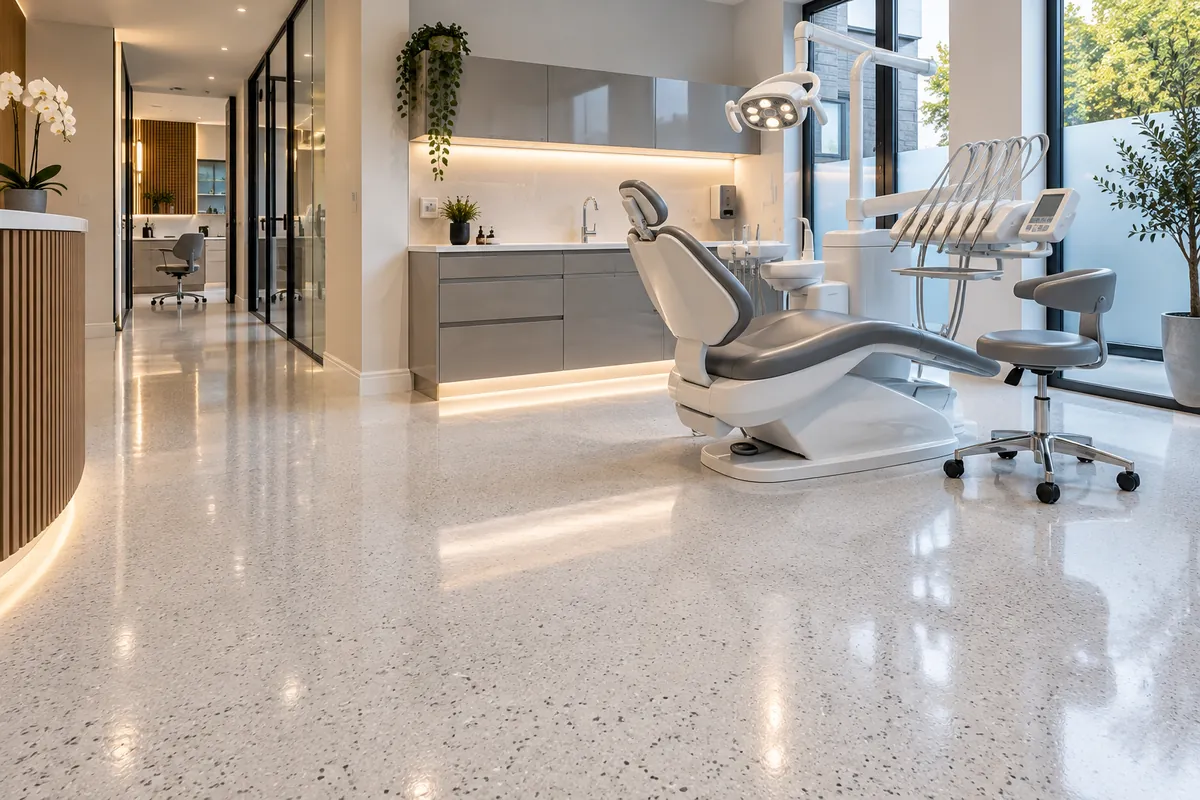
Quartz flooring is a resin floor system where coloured quartz aggregates are bound into epoxy and sealed with a clear coat. The quartz does three jobs at once: it gives the floor its speckled, natural stone colour, it adds texture for grip, and it builds a tough, hard-wearing layer that copes with heavy use.
Unlike tiles or vinyl, a quartz resin floor is laid as one continuous surface. There are no grout lines to stain and no welded seams to lift, which is why it has become a go-to floor for businesses that need to stay spotless.
Where does quartz flooring work best?
Across Romford, Ilford and East London we lay quartz floors most often in clinics, dental surgeries, salons and commercial kitchens, where hygiene and grip are non-negotiable. The floor can be coved up the wall edge, so there is no joint for dirt or bacteria to collect, and it stands up to daily deep cleaning.
At home, quartz suits kitchens, utility rooms, boot rooms and downstairs bathrooms. Families in Hornchurch and Brentwood often choose it for the room that sees muddy boots, dogs and spills, because it is practical without looking industrial.
How does quartz compare with tiles and vinyl?
Tiles look good on day one, but grout lines discolour and crack over time, and every joint is somewhere for water and dirt to sit. Safety vinyl is practical but can tear, dent and look tired quickly. A quartz resin floor is seamless, harder-wearing than both and far easier to keep clean, which is why so many local businesses are replacing old vinyl with it.
Is quartz flooring slippery?
No. The quartz aggregate gives natural texture underfoot, and the level of slip resistance can be specified to suit the space, from a family kitchen to a wet prep area in a restaurant. That built-in grip is one of the main reasons clinics and kitchens choose it.
How much does quartz flooring cost?
Quartz floors are priced per square metre. The cost depends on the size of the area, how much preparation the existing floor needs, whether you want coving at the wall edge and the colour blend you choose. The quickest way to get an idea is to WhatsApp us a few photos and the rough size. We send an initial estimate, then confirm a fixed written price after a free survey anywhere in Essex or London.
Should you choose quartz flooring?
If you want a hygienic, grippy, hard-wearing floor with a subtle natural look, quartz is an excellent choice, especially for clinics, salons and busy kitchens. If you want the floor to be a statement, look at metallic epoxy. If you want a soft, matt, mineral finish that can run up walls and into showers, microcement may suit you better. We bring samples of all three when we survey, so you can compare them in your own light.
Want to see it in person? Explore our quartz resin flooring page, or book a free survey with samples anywhere in Essex or London.
Frequently asked questions
Is quartz flooring good for a kitchen?
Yes. It is seamless, easy to clean and slip resistant, which makes it a practical choice for family kitchens and commercial kitchens.
Do you install quartz flooring in Romford and Essex?
Yes. We are based in Romford and install quartz resin floors across Essex and London, including Hornchurch, Brentwood, Chelmsford and Ilford.

 Our kitchen floor, RM11. Could this be microcement? About 25m²